
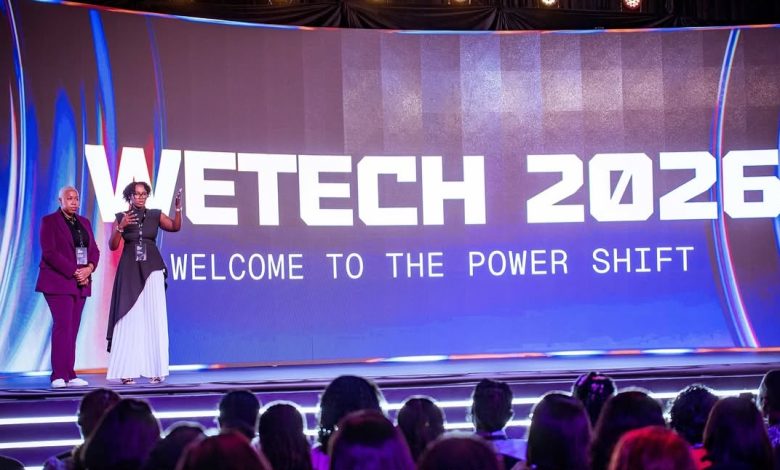
Africa needs to move beyond consuming artificial intelligence technologies developed elsewhere and build its own AI capabilities, while more women must have a stronger role in shaping decisions across the continent’s technology ecosystem.
That was one of the key messages from the Wetech 2026 flagship conference, held on September 26 at the Landmark Event Centre in Victoria Island, Lagos.
Themed “The Power Shift: Women Leading the Future of AI, Capital, and Innovation,” the conference brought together women in technology, founders, investors and other professionals from across Africa to discuss the future of AI, innovation, access to capital and women’s participation in decision-making.
Africa Must Build Its Own AI Capabilities
A major discussion at the conference focused on Africa’s dependence on foreign artificial intelligence models and the need for the continent to develop its own AI infrastructure, data resources and intellectual property.
During a panel titled “AI Moment, Partnerships & Talent for the Next Decade,” Oremeyi Akah, Chief Customer Officer at Interswitch; Professor Chika Yinka-Banjo, Director of AI Unipod at the University of Lagos; and Nneamaka Ihuoma, Head of Business Acquisition & Partnerships at Providus Bank, examined the opportunities and challenges facing Africa’s AI ecosystem.
The session was moderated by Isioma Utomi, founder of Catalyst Experience Solution.
Professor Chika Yinka-Banjo stressed that ownership of data should be at the centre of Africa’s AI ambitions.
According to her, data provides the foundation on which AI models are developed, and relying heavily on foreign datasets and models can limit their ability to accurately reflect African realities.
The panellists argued that AI systems trained primarily on foreign data may not adequately address the needs and circumstances of African users. They called for greater investment in research, education and policy to enable African institutions and companies to develop sustainable AI capabilities locally.
Ihuoma also pointed to the importance of intellectual property ownership, arguing that Africa’s role in the AI economy could remain largely that of a consumer if the continent does not develop and own more of the technologies it uses.
She called for stronger investment in research and education and greater policy support for locally developed AI solutions.
Technology Must Solve Real Problems
The discussion also emphasised that technological development should be driven by practical needs rather than technology for its own sake.
Ihuoma argued that innovators should first identify the problem they are trying to solve and then develop solutions that fit the realities and circumstances of their intended users.
The approach reflects a broader emphasis at the conference on building technology that responds to local challenges while creating sustainable businesses and opportunities.
Women Need a Stronger Voice in Decision-Making
Women’s participation in policymaking and leadership was another major theme at Wetech 2026.
A panel titled “From Policy to People: How Global & National Decisions Shape Women’s Realities” examined how policies and regulations can influence women’s income, business opportunities and access to technology.
The panellists argued that women need greater representation in positions where policies and institutional decisions are made. They also encouraged women to use their platforms, businesses and creative work to contribute to policy discussions and demand greater representation.
Sade Dada highlighted the disparity between women’s share of Nigeria’s population and their representation in the corporate sector.
“Women in Nigeria are half the population, but in the corporate world, women are only 29%,” Dada said, stressing that decision-makers may fail to understand women’s experiences when women are absent from the rooms where policies are developed.
Morayo Adisa similarly emphasised the consequences of women being excluded from decision-making processes, noting that decisions may subsequently be made based on assumptions that do not reflect women’s actual experiences.
The panel also called for stronger mentorship and sponsorship programmes to help women advance into decision-making roles, alongside sustainable programmes and broader systemic interventions.
Founders Share Lessons on Building in Africa
Another session, “Building, Funding & Scaling as a Founder in Africa,” brought together Adesuwa Omoruyi, Co-founder of Accrue; Tosin Faniro-Dada, Partner at Breega; Oyindamola Oladosu, Principal at Boston Consulting Group; and Miishe Addy-Asare, CEO of Jetstream.
The discussion, moderated by Chinyere Inya, Managing Partner at Accelerate Africa and Itana, explored the realities of building startups in an environment shaped by economic volatility, changing markets and limited resources.
The founders discussed business pivots, macroeconomic pressures and the importance of understanding a company’s underlying economics.
Addy-Asare explained that Jetstream did not begin generating significant revenue until the company moved beyond focusing primarily on its technology and began customising its offering. She said it took approximately a year and a half for the company to fully understand where technology was most relevant to its business.
Omoruyi also recounted how economic conditions in 2022 forced her company to reconsider its original direction.
She stressed the importance of maintaining conviction in a business idea while remaining prepared to adapt when circumstances change.
For Faniro-Dada, financial understanding remains essential for founders seeking investment.
She urged entrepreneurs to understand their unit economics, customer retention and cohorts, arguing that strong storytelling alone is not enough to demonstrate the strength of a business to potential investors.
Wakamedics Wins PitchHer 2026
The conference also featured a pitch competition showcasing startups and innovations developed by participating founders.
Victoria Duru of Wakamedics emerged as the overall winner and received a ₦5 million prize.
Blessing Aniefiok of Dynalimb Technologies finished as first runner-up, receiving ₦2.5 million, while Ogunlana Misi of TFB Studios AI placed second runner-up and received ₦1 million.
Other participants included Anjolaoluwa Ajayi, founder of ACADAI; Onyeka Nweze, founder of UNIKORRN; and Kamnsi Arachie, founder of JEWE Energy and Mobility.
Building the Next Generation of African Technology Leaders
The event also featured sessions on Wetech Communities and “Breaking into AI & Emerging Technologies,” with speakers from organisations including Interswitch, Moniepoint, Google, PwC and Samsung.
For Flora Uwadiegwu, co-founder of Wetech, bringing women together to exchange experiences is an important part of building the continent’s technology ecosystem.
She encouraged participants to take the knowledge gained at the conference and apply it by developing solutions capable of improving everyday life.
The discussions at Wetech 2026 ultimately connected two closely linked priorities: developing African technological capabilities and ensuring that women have a meaningful role in shaping them.
As Africa’s technology sector continues to expand, the conference highlighted the importance of local ownership of data and intellectual property, stronger investment in research and talent, and broader participation by women in the decisions shaping the continent’s digital future.