
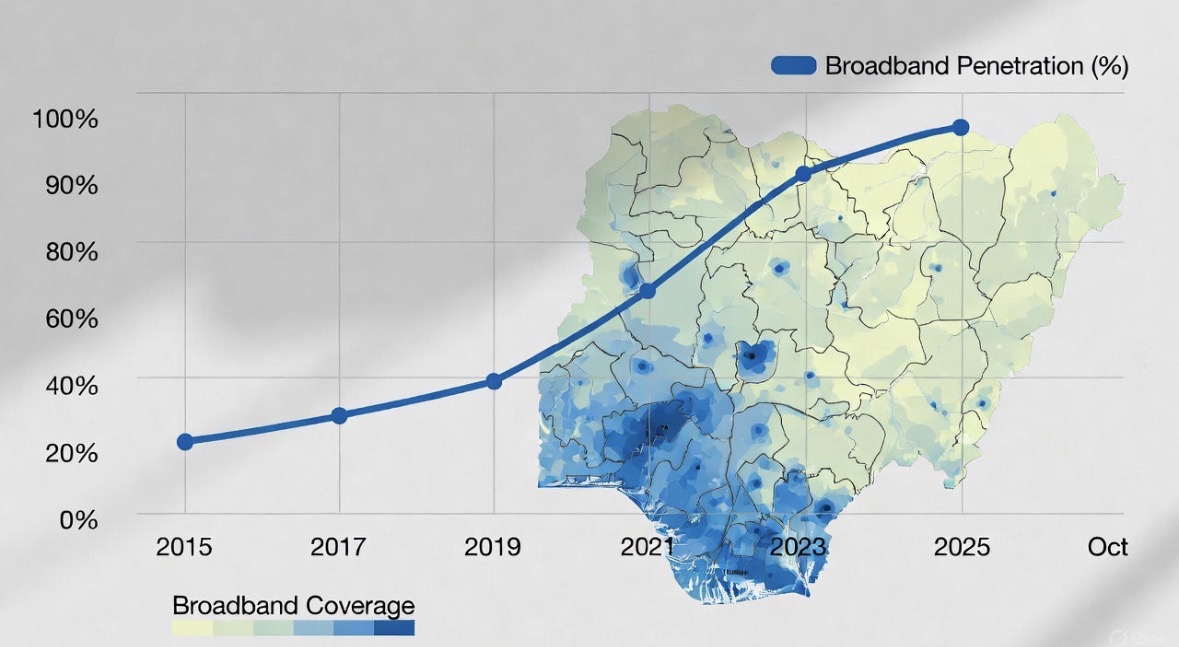
Nigeria broadband penetration reached 49.89 percent as of October 2025 according to the latest official data from the Nigerian Communications Commission (NCC). This figure marks the highest level recorded in 2025 and reflects gradual progress driven by mobile network growth. However the country missed the ambitious 70 percent target set in the National Broadband Plan (NBP) 2020–2025 which expired at the end of December 2025.
No official NCC statistics for November or December 2025 were released confirming the shortfall against the plan’s primary goal. The October data with approximately 108 million broadband subscriptions highlights both achievements and persistent barriers in achieving widespread digital connectivity.
Table of Contents
• Introduction to Nigeria Broadband Penetration
• Current Statistics and Growth Trends
• Challenges Hindering Broadband Expansion
• Key Drivers of Recent Progress
• Outlook Beyond the 2025 Target
Introduction to Nigeria Broadband Penetration
Nigeria broadband penetration showed steady improvement in 2025 primarily through expanded mobile broadband services and increasing smartphone adoption. The National Broadband Plan (NBP) 2020–2025 aimed to deliver 70 percent penetration effective coverage to at least 90 percent of the population minimum download speeds of 25 Mbps in urban areas and 10 Mbps in rural regions and data affordability at no more than ₦390 per 1GB.
The most recent confirmed rate of 49.89 percent in October 2025 demonstrates incremental gains but also underscores the challenges in overcoming infrastructure limitations and regulatory hurdles for full nationwide inclusion.
Here are visualizations of broadband penetration trends and coverage patterns in Nigeria:
These charts illustrate the gradual increase over the year.
Current Statistics and Growth Trends
Nigeria broadband penetration stood at 49.89 percent in October 2025 up from 49.34 percent in September and 48.81 percent in August. Broadband subscriptions reached around 108 million by October following rises from 106 million in September and 105 million in August.
The growth remained modest and uneven with monthly fluctuations throughout the year. The country ended 2024 at 44.43 percent and had missed earlier interim targets. With the NBP now expired and no verified data beyond October the 70 percent objective was not achieved.
Coverage maps highlight the ongoing urban-rural disparities:
Challenges Hindering Broadband Expansion
Multiple structural issues have slowed advances in Nigeria broadband penetration. Frequent fibre optic vandalism disrupts services and increases costs significantly. High Right-of-Way fees imposed by states multiple taxation layers and high energy requirements for base stations create substantial barriers especially in rural areas.
Limited fibre rollout beyond major cities along with subscriber variations earlier in 2025 have left many populations underserved. These factors contributed to the notable gap between current levels and the original NBP targets.
Key Drivers of Recent Progress
Mobile broadband has been the primary force behind improvements in Nigeria broadband penetration. Continued deployment of 3G and 4G networks along with emerging 5G in urban areas has expanded access. Lower smartphone prices and competitive data packages from operators have encouraged broader mobile internet usage.
Here are examples of how Nigerians use mobile internet in daily life:
Policy support from the NBP and private investments in backbone infrastructure have promoted growth in underserved regions. For global broadband perspectives refer to external resources such as the ITU broadband statistics
Outlook Beyond the 2025 Target
The Nigerian Communications Commission emphasizes continued investment in mobile and fibre networks along with reforms to reduce deployment costs and improve infrastructure protection. Although the 70 percent target under the expired NBP was not met the progress in 2025 lays groundwork for future development.
A successor strategy is anticipated to prioritize accelerated rural expansion cost reductions and stronger regulatory measures to enhance digital inclusion and support the telecommunications sector’s role in economic growth.