Physical Address
4 Elgon Terrace, Kololo, Kampala, Uganda
Physical Address
4 Elgon Terrace, Kololo, Kampala, Uganda
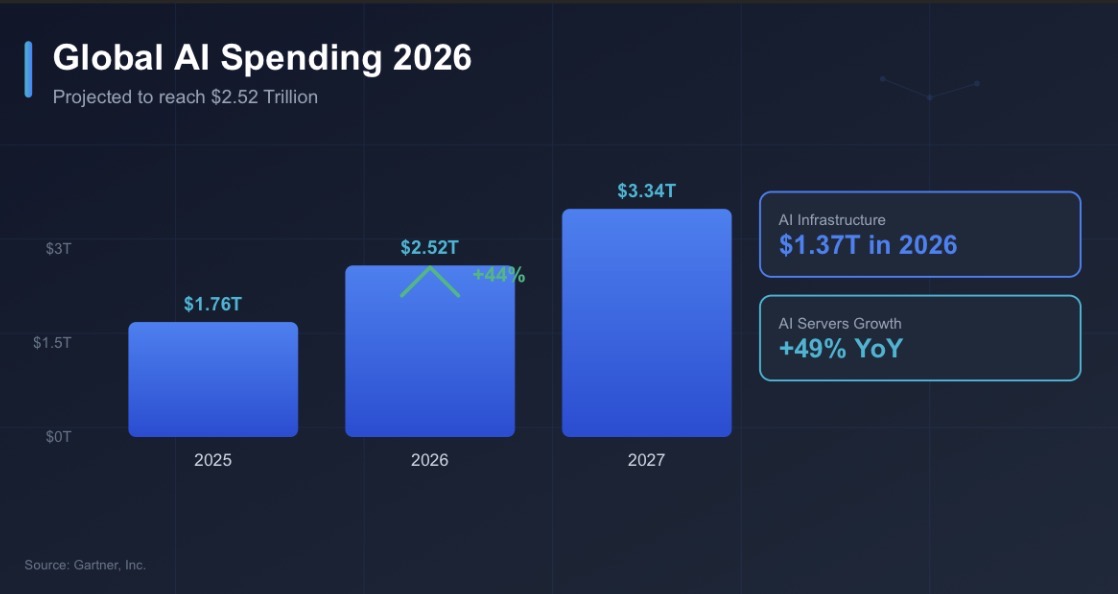
Worldwide spending on artificial intelligence is projected to reach $2.52 trillion in 2026, representing a 44% year on year increase, according to new forecasts from Gartner, Inc. This dramatic surge in AI spending underscores how artificial intelligence continues its transformation from experimental deployments to large scale enterprise infrastructure, even as organizations become increasingly selective about where and how they invest their AI budgets.
Enterprise AI Adoption Enters Maturity Phase
Gartner notes that AI adoption in 2026 will be driven less by speculative innovation and more by organizational readiness, including skills development, process optimization, and measurable business outcomes.
As enterprises move through what Gartner describes as the “Trough of Disillusionment,” artificial intelligence is increasingly being adopted through existing software vendors rather than new, high-risk AI projects. This strategic shift reflects growing demand for predictable returns on AI investment before artificial intelligence can be scaled more broadly across enterprises.
The transition marks a critical evolution in how businesses approach AI spending. Rather than pursuing standalone AI initiatives, organizations are focusing on integrating artificial intelligence into core business systems where proven use cases can deliver immediate value. This more disciplined approach to AI adoption suggests that the technology is maturing beyond the hype cycle into practical business applications.
A major driver of AI spending growth is infrastructure investment, as technology providers race to build foundational capabilities necessary for enterprise scale artificial intelligence deployment. Spending on AI-optimized servers alone is expected to rise by 49% in 2026, accounting for 17% of total AI expenditure. Overall, AI infrastructure investments are projected to add $401 billion in spending during the year, highlighting the capital-intensive nature of building scalable AI ecosystems that can support growing enterprise demands.
This infrastructure-focused AI spending reflects the fundamental requirements for running sophisticated artificial intelligence applications at scale. From specialized computing hardware to enhanced data storage and processing capabilities, organizations are making substantial investments in the technological foundation that will power their AI initiatives for years to come.
According to Gartner’s breakdown by market segment, AI infrastructure will remain the largest spending category, growing from approximately $965 billion in 2025 to $1.37 trillion in 2026, and reaching $1.75 trillion by 2027. This represents the most substantial portion of overall AI spending and demonstrates where organizations believe they need to invest to enable future artificial intelligence capabilities.
AI services are forecast to grow to nearly $589 billion in 2026, while AI software spending is expected to reach $452 billion. These categories represent the implementation, customization, and ongoing support services that enterprises require to successfully deploy artificial intelligence solutions, as well as the software platforms that enable AI applications across various business functions.
Other fast growing segments within AI spending include AI cybersecurity solutions, AI models and algorithms, data science and machine learning platforms, and AI application development platforms. Each of these categories addresses specific enterprise needs as organizations build comprehensive artificial intelligence strategies that span security, development, and operational deployment.
In total, worldwide AI spending is expected to climb from $1.76 trillion in 2025 to $3.34 trillion by 2027, signaling sustained long-term growth despite short term enterprise caution about artificial intelligence investments. This projected trajectory indicates that while organizations may be more selective about individual AI projects, overall commitment to artificial intelligence technology continues to accelerate as businesses recognize its transformative potential.
Gartner emphasizes that as AI matures, success will increasingly depend on disciplined execution, proven use cases, and the integration of artificial intelligence into core business systems rather than standalone initiatives.
Organizations that can effectively align their AI spending with strategic business objectives while building the necessary infrastructure and capabilities will be best positioned to capture value from their artificial intelligence investments.
Gartner will provide deeper insights into global AI, data, and analytics trends at its Data & Analytics Summits 2026, scheduled across major cities including Orlando, São Paulo, London, Tokyo, Sydney, and Mumbai.
These events will offer organizations worldwide the opportunity to refine their AI strategies in an increasingly infrastructure driven market where disciplined AI spending and proven returns on investment have become paramount considerations.
As artificial intelligence continues its evolution from emerging technology to enterprise essential, the focus on infrastructure, readiness, and measurable outcomes suggests that 2026 will be a pivotal year for AI adoption.
Organizations that approach AI spending strategically, balancing infrastructure investment with proven use cases and organizational capabilities, will be best positioned to capitalize on the technology’s transformative potential while managing risks and ensuring sustainable returns on their artificial intelligence investments.